


Microsoft Copilot Checkout and Google’s UCP are shaping agentic ecommerce
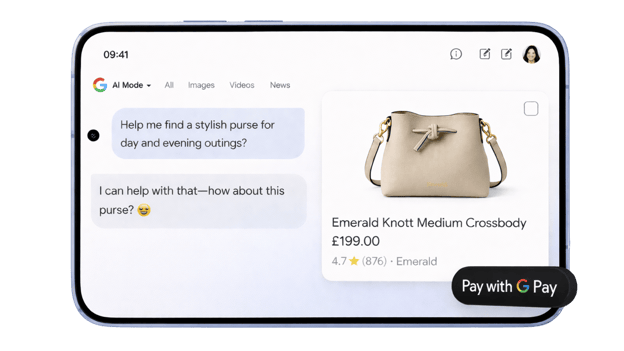
We are seeing the early shape of agentic commerce, where AI assistants can help customers discover products and complete a purchase within the same experience, rather than handing them off to a website.
The last “one step” shift happened through social commerce, when platforms like Instagram and TikTok made it possible to buy without leaving the app. Now AI is accelerating that pattern across industries as it matures. Merchants and service providers have little choice but to adapt as customer expectations change.
Recently, Microsoft’s Copilot Checkout, supported by partners including Stripe, launched “buy” actions directly into Copilot so shoppers can purchase without bouncing across multiple sites. At the same time, Google and Shopify have introduced a standard designed to help AI agents communicate with merchant systems across discovery, basket, checkout, and even post-purchase support.
As payments, product data, and retailer integrations become more standardised for AI-led journeys, it points to a future of more creative, faster, and more intentional shopping experiences.
Microsoft Copilot Checkout partner for faster conversions
Microsoft is turning Copilot into a place where shopping can be completed, not just researched. With Copilot Checkout, users can ask for a product, compare options, and then select a Buy button that opens an in-chat checkout experience.
Microsoft has confirmed partnerships with Stripe, PayPal, and Shopify to support secure, low-friction transactions inside these AI-led journeys.
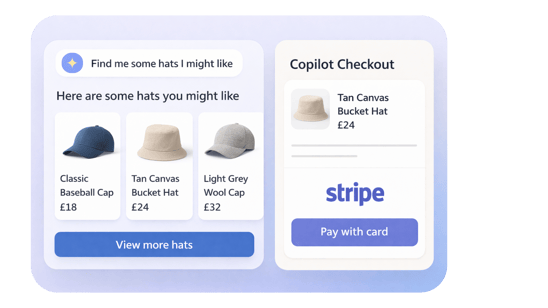
For ecommerce teams, Copilot Checkout signals that conversion can happen in more places:
-
Discovery and checkout are converging. If the customer can complete a purchase at the moment of intent, fewer steps can mean fewer drop-offs.
-
Platforms are becoming new storefronts. Copilot becomes a shopping interface in its own right, which changes how brands think about product feeds, merchandising, and attribution.
-
Payments and identity need to be seamless. The strongest businesses will support fast, secure checkout without forcing customers to re-enter details repeatedly.
Google and Shopify expanding AI shopping
Copilot Checkout shows what AI-led checkout looks like on one platform. Google and Shopify’s announcement is about making these experiences easier to build and scale across the ecosystem.
Google has launched a Universal Commerce Protocol (UCP), an open-source standard that helps AI assistants and ecommerce systems share the information they need to complete a purchase reliably. They are pushing more AI-led shopping surfaces across Search and Gemini, and Shopify is one of the biggest routes to market for merchants. UCP is essentially an attempt to stop AI commerce becoming fragmented into lots of one-off integrations.

We think this is more than a trend
It’s easy to dismiss AI-led shopping as another shiny ecommerce experiment. What’s different this time is that the industry is putting foundations in place that make these experiences repeatable, secure, and scalable. We are not seeing one company testing in isolation. Multiple major platforms and commerce players are investing simultaneously, and they’re doing it in ways that touch real transactions, not just product recommendations.
There’s also a wider consumer change already underway. People are getting used to using AI to shortcut decisions, from research and comparison to picking the option for a specific need. Shopping is a natural extension of that. If customers increasingly begin their journeys with a question rather than a category page, then AI assistants become an obvious new starting point for ecommerce, especially when they can reduce the number of steps between intent and purchase.
That said, this does not mean it will be frictionless. AI-led commerce raises the bar for reliability because the promise is convenience. If anything breaks the flow, customers will lose confidence quickly. The adoption will depend on whether these experiences can be trusted end-to-end.
Address errors can break the agentic shopping experience
.png?width=725&height=207&name=ecommerce%20ecosystem%20(1).png)
Agentic commerce is built around the idea that purchasing should feel effortless. That only works if the information captured at checkout is correct, and one of the most important details in fulfilment is the delivery address.
The payments are done through Apple Pay, Google Pay, PayPal etc, where the address is either manually typed, selected from a wallet profile, auto-filled by the browser, or pulled from an account that hasn’t been updated in years. With one step purchasing, shoppers are more likely to continue than pause and double-check the details, which leaves room for errors.
In ecommerce, a wrong or incomplete address is already costly. It can mean failed deliveries, reshipments, returns, chargebacks, more support tickets and poorer customer reviews.
If Agentic shopping is going to become a habit, address quality needs to be built into the process. A sensible approach usually includes two layers:
Address validation at the point of entry: helping the customer select a verified, correctly formatted address before the order is placed.
Data cleansing after capture: formatting and correcting address records once they enter back-office systems, so downstream teams are working with consistent data.
The point is that no matter how advanced the interface becomes, address quality still needs to be part of the journey.
What’s Next?
We’re excited to see how agentic commerce develops, and we’re not just watching from the sidelines. We’re building AI and machine learning products that make the address data more reliable, so merchants and customers can trust them as they scale.
Stay tuned!