


Address accuracy matters as customers switch provider more often

As fibre networks expand and switching processes improve, customers are finding it easier to change provider when their contract ends or when a better option becomes available. As a result, providers are seeing customers move more frequently than they did in the past.
In the UK, Ofcom’s One Touch Switch (OTS) allows customers to switch provider by contacting only their new provider, removing much of the friction that previously slowed the process.
This is positive for customers. For broadband providers, wholesalers and anyone operating a provisioning stack, however, it means competition intensifies as fibre coverage expands and customers are more willing to move.
As switching becomes more automated, customer address accuracy becomes an essential dependency, not just a billing field. It underpins how providers match records, place orders, schedule installations and deliver equipment when customers change provider.
Why broadband switching is accelerating
Switching friction is being removed
In the UK, Ofcom’s One Touch Switch (OTS) process allows customers to switch broadband or landline provider by contacting only their new provider. The new provider is responsible for coordinating the switch and managing any issues that arise.
One year after launch, more than 1.6 million customers had switched landline or broadband provider using the process.
Fibre rollout increases customer choice
Full-fibre coverage has expanded rapidly in the UK and across Europe. Many homes and businesses now have multiple viable networks available at a single location, including incumbent fibre, cable and alternative network operators. A KPMG report on UK fibre notes full-fibre coverage was ~52% in summer 2023, rising to 69% (20.7 million homes) by late 2024, with intensified competition and signs of customers moving to alternative networks.
As coverage increases, switching becomes less about whether switching is possible, and more about how easy it feels. When choice and ease align, churn rises naturally, even when service quality is strong.

Switching runs on matching, and matching runs on addresses
It is easy to think of broadband switching as a regulatory or commercial process. In reality, it is a data-matching problem.
Whether a customer is switching under One Touch Switch, moving between wholesale platforms, or ordering service on a new fibre network, the same requirement applies: systems must agree they are talking about the same physical location.
The most important matching key is often the address. The address acts as the shared reference point between organisations that do not share a single customer database.
As switching and provisioning become faster and more automated, there is less tolerance for manual correction. What used to be fixed by a phone call or an experienced agent now becomes a failed order or a delayed installation.
How bad address data turns into churn
Failed matching
If a customer’s entered address does not match the losing provider’s records, the switch may not proceed automatically. Even small differences, such as abbreviations, missing flat numbers or inconsistent building names, can be enough to break matching.
Delays at this stage undermine confidence. Customers may abandon the switch, cancel the order, or blame the new provider for a process that feels unreliable.
Wrong location selected
In ambiguous cases, selecting an address that looks similar but is not exact can result in an order being placed against the wrong location. This can occur often with addresses in rural areas. Industry bodies have warned that this creates a risk of erroneous switches, which are costly to unwind and damaging to customer trust.
These errors are rarely caused by bad intent. They are almost always rooted in unclear or inconsistent address data.
Install failures
Broadband delivery is physical. Engineers need to find the correct entrance, cabinet, line or port. In multi-dwelling buildings, missing or unclear sub-premises information significantly increases the chance of a failed first visit.
Every missed appointment creates cost, frustration and delay, and it often becomes the customer’s defining experience of a new provider.
Address accuracy is now an operational lever
As churn accelerates, address data quality has a direct impact on growth, cost control and customer experience. Improving it does not require a complete system overhaul, but it does require treating addresses as structured data, not free text.
Validate at the moment of capture
The most effective time to improve address quality is when the customer enters it. This includealts:
-
Using postcode lookup or address finder to capture accurate addresses on a form
-
Prompting customers when multiple matches exist
-
Requiring sub-premises details such as flat or unit numbers where relevant
Store a location identifier alongside the address.
In Great Britain, the most widely used identifier is the Unique Property Reference Number (UPRN). UPRNs are persistent and never reused, which makes them suitable for linking records across systems.
Storing a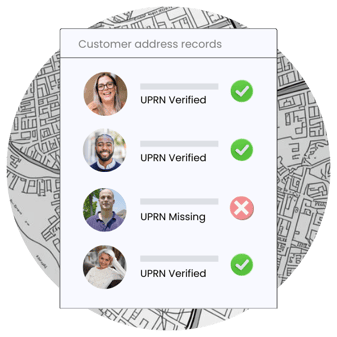 UPRN alongside the formatted address helps ensure that different teams and platforms are referring to the same physical place.
When providers and wholesalers use UPRNs consistently:
-
Address matching becomes more reliable
-
The risk of selecting the wrong flat or unit is reduced
-
Engineer visits are easier to plan and complete
-
Equipment deliveries are more likely to arrive first time
BT Wholesale describes UPRNs as reducing error in data exchange and helping engineers locate premises faster, especially in buildings with multiple organisations sharing the same address.
FAQ
What is broadband churn?
Broadband churn measures how many customers leave or switch providers over a given period. Network churn often refers to customers moving between different underlying access networks, such as between fibre providers or from cable to fibre.
Why is broadband switching increasing?
Switching is increasing because customers have more choice and fewer barriers. Regulatory changes have simplified the switching process, and fibre rollout has made competing networks available at the same address.
How does address accuracy affect switching?
Switching relies on matching customer records between providers. If addresses are incomplete, inconsistent or ambiguous, matching can fail, causing delays, failed switches or incorrect orders.
What is a UPRN and why does it matter?
A UPRN is a unique identifier for an addressable location in Great Britain. It removes ambiguity by linking systems to the same real-world premises, particularly in complex buildings with multiple units.